

Escaping trafficking is a courageous step, but it often leaves victims with fear and uncertainty about where to turn next. Many people are left unsure about their rights and their safety. For some victims, the best option is to seek a T Visa, which allows them to remain in the United States. No victim should have to navigate the legal system alone after going through something like this. At Alonso & Alonso, our T visa lawyers bring more than 15 years of experience helping clients live safely in the United States. Contact us today for assistance.
Key Takeaways
What is a T Visa?
The T visa is a special form of immigration relief for survivors of human trafficking (forced labor, sex work, involuntary servitude) that allows them to remain safely in the United States.
Purpose:
It was created under the Victims of Trafficking and Violence Protection Act to protect survivors from deportation, provide a safe path to stay in the U.S., and encourage victims to report trafficking crimes to law enforcement.
Benefits and Status:
A T visa grants legal nonimmigrant status for up to four years, automatic work authorization, protection from deportation, and access to federal and state public benefits.
Pathway to Green Card:
T visa holders and eligible family members can apply for Lawful Permanent Resident Status (a Green Card) after maintaining T status for three years and meeting other requirements.
Family Inclusion:
T visa holders (T-1) can include certain immediate family members (T-2, T-3, T-4, T-5), such as spouses, children, parents, and sometimes siblings, depending on the victim’s age and danger level.
Application Process:
The primary application is Form I-914, which should include a personal statement, evidence of trafficking, and supporting documents. Inadmissibility waivers (Form I-192) are also available.
T Visa vs. U Visa:
The T visa is specifically for force labor and human trafficking survivors. The U visa is for victims of a broader range of serious qualifying crimes who have actively cooperated with law enforcement, a requirement that is more flexible for T visa applicants.
Role of Alonso & Alonso:
The firm provides trauma-informed legal support with over 15 years of experience, helping applicants prepare evidence, file necessary documents, coordinate with authorities, and avoid mistakes that can lead to denials.
What Is a T Visa?
The T visa is a special form of immigration relief for individuals who have escaped human trafficking. It’s designed for those subjected to forced labor, manipulated into working off false debts, or who faced harm and threats while being controlled by traffickers, employers, or smugglers, whether through abuse, stolen papers, or other forms of coercion.
Unlike U visas, which apply to certain victims who assist police, or asylum meant for those fleeing general persecution, the T visa focuses directly on helping survivors of trafficking regain safety and a fresh start in the U.S.
What Is the Purpose of a T Visa?
The T visa, created by Congress under the Victims of Trafficking and Violence Protection Act/Trafficking Victims Protection Act, keeps survivors of human trafficking safe from deportation and gives them legal rights. It was designed to help people who were forced into labor or sex work stay in the United States. Ultimately, it does the following:
Encourages Victims to Report Trafficking Crimes
Allowing victims who may not be in the United States legally to report trafficking crimes without being immediately removed from the country means they’re more likely to report these crimes. This helps combat trafficking and helps more victims.
Provides a Safe Path to Remain in the U.S.
A T visa enables survivors and certain family members to reside in the United States legally. This visa status protects them from being sent back to dangerous conditions.
Offers Stability and Access to Services
A T visa helps individuals rebuild their lives by enabling them to obtain work permits, access social services, and receive medical assistance to recover both physically and emotionally.
Victims of trafficking shouldn’t have to choose between remaining in the country as a trafficked person or reporting the crimes and being deported. Fortunately, the T Visa helps solve this issue.
Who Qualifies for a T Visa? Understanding Eligibility Requirements
Getting a T visa isn’t guaranteed. Understanding the requirement is essential so you know if you have a chance at obtaining one or not. First, you must be located within the United States or in another place the U.S. oversees, such as a port of entry, certain U.S. territories, or areas like American Samoa or the Northern Mariana Islands, due to a trafficking situation. You also must clearly identify yourself as a human trafficking survivor.
This could include those forced or deceived into sex trafficking (like being made to participate in paid commercial sex acts against your will) or those rescued from labor trafficking/involuntary servitude, where someone made you work or provide services using threats, lies, exploitation, or cruelty.
It does not require unusual and severe harm, and a police investigation or prosecution is not required for a person to seek a T visa.
Additionally, most people must be “admissible” to get a T visa, meaning you pass basic legal safety checks for entering/staying in the U.S. If you don’t qualify automatically, waivers are sometimes available, especially because T visas are a humanitarian protection.
Who Else Can You Include on Your T Visa Application?
If your family members face real and immediate danger, your T visa can also cover your parents, your unmarried siblings under 18, and the children (of any age or marital status) of those eligible relatives.
If there is no present danger to your family, what you can do depends on your age:
- If you are under 21: You may include your spouse, unmarried children under 21, parents, and unmarried brothers or sisters who are under 18.
- If you are 21 or older: You can include only your spouse and unmarried children under 21 in your application.
Your T visa lawyer can guide you through each step, ensure you and your family meet these and all other eligibility requirements, and help protect both you and your loved ones.
What Is a T Visa Holder?
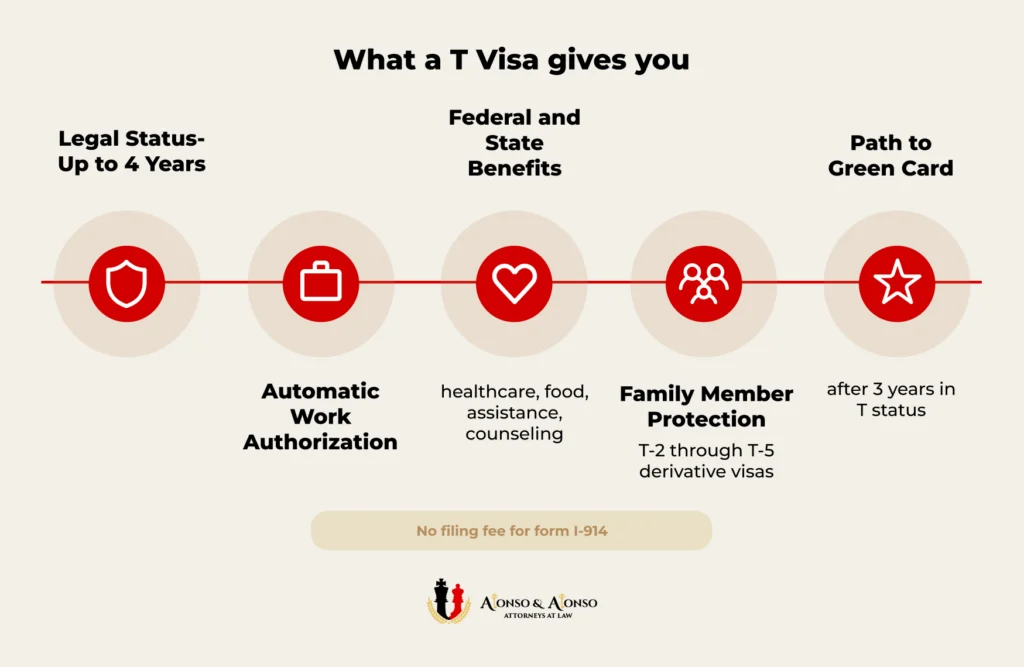
Many people searching for “what is a T visa holder” want to understand the full rights and options that come with T nonimmigrant status. For victims of human trafficking (sometimes including those suffering extreme hardship involving unusual or severe forms of abuse), this visa was designed as both a humanitarian and protective tool.
Once granted, T nonimmigrant status leads to valuable benefits and a new path for survivors and their family members. Importantly, collaboration with law enforcement officials or proving a “severe” form of trafficking isn’t required – a victim simply needs to meet eligibility requirements, show they are physically present in the United States because of human trafficking, and that they have suffered physical or mental abuse because of trafficking.
Legal Nonimmigrant Status and Four-Year Validity
A person approved for a T visa gains legal nonimmigrant status and can remain in the United States for up to four years. This timeframe provides stability and protection from deportation, allowing T visa holders to recover and plan for their future.
Automatic Work Authorization
T visa holders are automatically eligible for work permits. The U.S. Citizenship and Immigration Services (USCIS) will provide work authorization, enabling the survivor to legally obtain employment and support themselves and their family members during their stay. Access to Federal and State Benefits.
Individuals holding T nonimmigrant visas, as well as eligible derivative family members, are eligible to access critical federal support programs. These include food assistance (like SNAP), state public benefits, and medical care.
Ability to Reunite with Family Members
T visa holders don’t need their trafficking case prosecuted to include certain family members for derivative T nonimmigrant status. The definition of “family member” for these purposes can include spouses, unmarried children, parents, and even siblings under some circumstances.
Pathway to Lawful Permanent Resident Status (Green Card)
After maintaining T nonimmigrant status and meeting eligibility requirements for three years, visa holders may apply for a Green Card (permanent resident status). Working with experienced immigration attorneys can significantly increase the chances of your application’s success.
How to Apply for a T Visa After Experiencing Human Trafficking
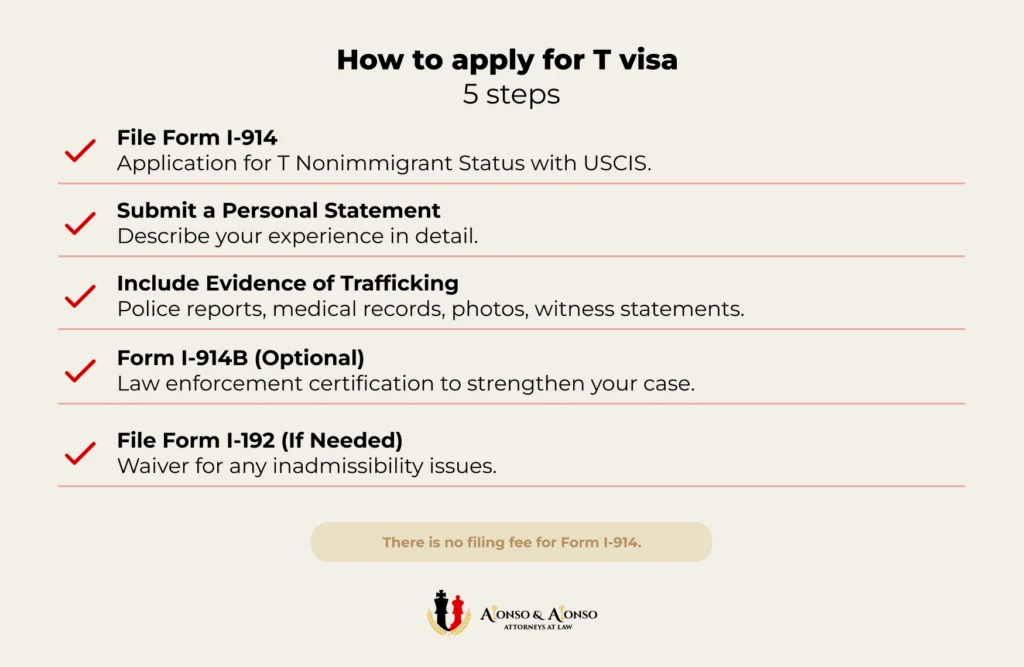
Applying for a T nonimmigrant visa as a victim of human trafficking can feel overwhelming, but breaking the process down makes it much easier to follow. Below are the necessary steps, explained simply so you know what to expect and can start your application with confidence.
File Form I-914
The first step is to complete and file Form I-914, the Application for T Nonimmigrant Status, with U.S. Citizenship and Immigration Services. This form asks about your background, your experience with trafficking, and information about any close family members applying as derivatives. You should keep copies of all documents for your records.
Submit a Personal Statement
You’ll need to include a written statement describing what happened to you in detail. The goal is to help immigration officials understand your experience, what you have suffered, and why remaining in the United States is important for your safety.
Include Evidence of Trafficking if You Have it
With your application, attach as much supporting evidence as possible. This can include police or medical reports, photos, messages, sworn statements from witnesses, agency records showing you asked for help, or anything else documenting that you were a victim of human trafficking.
Law Enforcement Certification – Form I-914B (Optional, But Helpful)
Form I-914B can be filled out and signed by a law enforcement agency or official (like a police officer, investigator, or prosecutor) to confirm you were helpful in the investigation or prosecution of your traffickers. Though it’s not required, submitting this form can strengthen your case.
Filing Waivers for Inadmissibility (Form I-192)
If you have situations in your background that would typically disqualify you from approval (such as past immigration issues or certain criminal convictions), submit Form I-192, Application for Advance Permission to Enter as a Nonimmigrant, along with your T visa package. If approved, this can “waive” or excuse those issues in your case.
Processing Timelines For T-nonimmigrant Status
USCIS reviews T visa applications carefully, which means approval can take several months, sometimes over a year, depending on individual cases, the need for additional information, or existing backlogs.
What Happens After You Submit Your Application?
You may receive a letter requesting additional information or an interview, so be sure to monitor your mail and respond promptly to any requests or appointments.
Having help from a T visa lawyer makes the entire T visa process less stressful and dramatically increases your chance of success.
Required Documents for a T Visa Application
Assembling the correct documents is crucial when applying for a T visa. Each item helps show you are eligible for protection as a trafficking survivor and helps immigration services decide on your case. Here’s what you’ll need.
1. Evidence of trafficking:
You must submit anything that proves you were a victim of trafficking, like details explaining what happened, where, and who was involved.
2. Medical reports, police reports, affidavits:
Copies of hospital records, doctors’ letters, police case numbers, or written statements from those who saw what you experienced can help back up your story. Your own personal statement of the ordeal is also incredibly valuable.
3. Proof of identity:
You’ll need to attach basic identification documents, such as a passport, birth certificate, driver’s license, or national ID, so immigration officials can verify who you are.
4. Proof of physical presence:
Documents showing you are currently in the United States for reasons related to trafficking may include rental agreements, school records, work stubs, or official letters sent to a U.S. address.
5. Hardship evidence:
Any paperwork or notes that show you would suffer serious problems – physical, financial, or emotional – if your application is not approved.
6. Supporting letters from advocates, lawyers, or service providers:
Letters from caseworkers, attorneys, social workers, or community organizations confirming the harm you suffered or your involvement in recovery and advocacy programs bring valuable support to your application. While they are not necessary, they can be valuable supporting evidence that increases the likelihood of your application being approved.
T visas are generally granted when all requirements are met. By collecting these documents and ensuring they accurately detail your experience and situation, you significantly increase the likelihood that your case will be approved.
T Visa vs. U Visa — What’s the Difference?
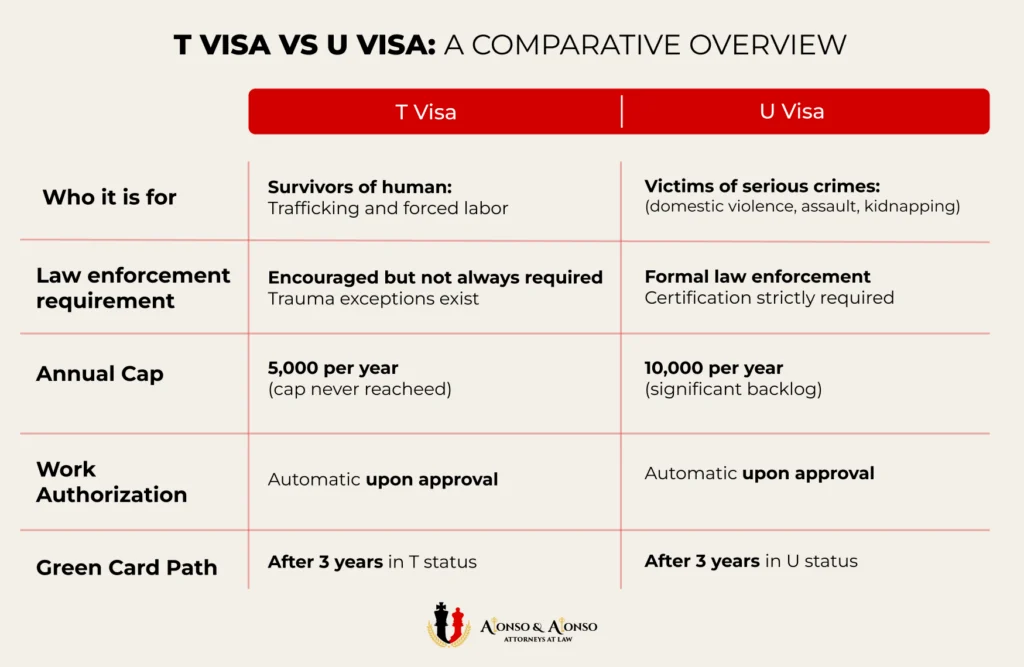
The T visa and U visa are both designed to protect people who have suffered from certain crimes, but they are intended for different situations and have unique requirements. The T visa is for individuals who have survived human trafficking in the United States, whether it involved forced labor or sex work. The U visa covers victims of a broader range of qualifying criminal activity – such as domestic violence, assault, or kidnapping – who have actively helped law enforcement in investigating or prosecuting the crime.
While the T visa strongly encourages cooperation with authorities, it does not always require formal law enforcement certification, and applicants may still qualify even without it, or where trauma makes collaboration impossible. For the U visa, certification from law enforcement proving your helpfulness is strictly required before approval.
Processing times for both visas can be lengthy, with wait lists and strict limits: the U visa has an annual limit of 10,000 grants, meaning long waits, while the T nonimmigrant visa is capped at 5,000 principal applicants per year (this has never been reached, but there are still backlogs because of slow processing times). Both create a path toward work authorization and eventually a Green Card.
Important Note: Processing times vary frequently. The information provided here may be outdated. For the most accurate and up-to-date processing times, please visit the official USCIS website.
Benefits of a T Visa for Victims of Trafficking
The T visa offers vital benefits to victims of trafficking who need a safe chance to start over. It allows you to stay lawfully in the United States for up to four years and grants you immediate permission to work, enabling you to support yourself and your family. T visa holders are protected from deportation, even if they don’t yet have legal status. They may also receive access to certain public benefits, such as healthcare, food assistance, or counseling, that help rebuild stability.
Most importantly, the T visa provides time and security for survivors to escape their traffickers, heal, and make a fresh start. After meeting certain conditions, the T visa also provides a clear pathway to permanent residency, enabling victims to build a long-term, safe life in the U.S.
Can Family Members Get a T Visa? (Derivative Visas)
When a person is approved for a T Visa, they can often get protection for their family members as well. Here’s an overview of how this usually works:
T-2: Spouse of the T-1 Victim:
The spouse of a T-1 visa holder can always qualify for a T-2 derivative visa, regardless of the principal applicant’s age.
T-3: Child of the T-1 Victim:
Any child of a T-1 visa holder can receive a T-3 derivative visa. There’s no age limit on the child as long as the T-1 is their parent and adds them to the application.
T-4: Parent of the T-1 Victim:
Parents of a T-1 victim can be added for a T-4 visa if the T-1 is under 21. A parent may also qualify at any time if they face immediate, serious danger because their child reported or cooperated in a trafficking investigation or prosecution.
T-5: Unmarried Sibling Under 18 of the T-1 Victim:
Unmarried siblings under 18 become eligible for a T-5 visa if the T-1 victim is younger than 21, or if that sibling faces threat or harm due to the T-1’s cooperation, regardless of the principal victim’s age.
Applicants need to be included on the T-1’s paperwork with proof of their relationship and meet the protection or age requirements.
How Long Does a T Visa Last?
A T visa is generally valid for up to four years, but extensions can sometimes be granted in certain cases, such as when the Green Card application takes longer to process. While you hold a T visa certification, you remain protected from deportation and have the legal right to work in the U.S. After three years, you can usually apply for permanent residence.
Can a T Visa Lead to a Green Card? (Adjustment of Status)
A T visa can lead to a green card if certain requirements are met. To qualify, you must have lived in the U.S. for at least three years after receiving T visa certification and have remained continuously physically present during that time. You need to show good moral character and not be barred by specific grounds of inadmissibility (waivers are available in many cases). Finally, you must file Form I-485 (Application to Register Permanent Residence or Adjust Status) and include documents proving you meet all these criteria.
Common Reasons T Visas Get Denied
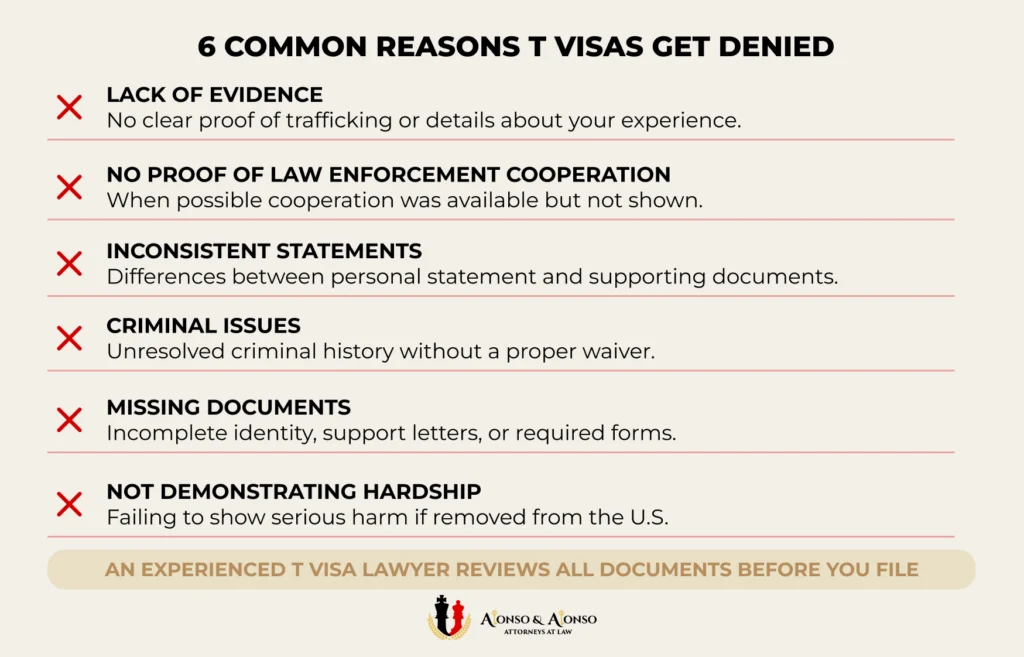
T visa applications are carefully reviewed, and even small mistakes or missing details can lead to denial. Knowing the most common reasons helps you prepare a stronger case from the start.
- Lack of evidence: Without enough proof of trafficking or details about your experience, it becomes difficult for immigration to approve the visa.
- No proof the victim assisted law enforcement: While not always required, failing to show any cooperation with authorities (when able) can make an application much weaker.
- Inconsistent statements: Differences in your personal statement and supporting evidence can cause USCIS to question your story.
- Criminal issues: Certain criminal offenses may block approval unless a proper waiver is filed and granted.
- Missing documents: Forgetting important pieces like identity documents, support letters, or required forms can stop your application from moving forward.
- Not demonstrating hardship: Failing to clearly show the type of extreme hardship you’d face if removed from the United States, or suffered because of trafficking, is a common mistake that can hurt your case.
The best way to ensure you submit all necessary documents for your application is to work with legal representation as soon as possible.
How an Immigration Lawyer Helps T Visa Applicants

An immigration lawyer is vital in guiding T visa applicants through the complicated process, and having Alonso & Alonso by your side brings dedicated trauma-informed care at every step.
- Our attorneys help prepare and organize all necessary evidence for your case, ensuring that nothing important is overlooked and your story is presented clearly and effectively.
- We coordinate directly with police, law enforcement, or victim advocates to collect any required documentation or support letters that can strengthen your claim.
- If you have immigration or criminal history that could complicate your case, we prepare and file any needed waivers on your behalf.
- We carefully review documentation to avoid common mistakes and missing pieces that can sometimes cause applications to be denied or delayed.
- If an immigration interview or hearing is scheduled, we’ll be there to help you.
By working with Alonso & Alonso, you increase your chances of being allowed to stay in the country and receive the help you need.
Contact Alonso & Alonso Attorneys at Law for a Free T Visa Case Evaluation
If you are experiencing forced labor or are a survivor of trafficking and are unsure where to turn next, contacting Alonso & Alonso Attorneys at Law can provide the guidance and safety you need. Our team combines years of experience in humanitarian cases with a truly trauma-informed approach, ensuring you and your story are treated with dignity and respect. Every conversation and document you share with us is kept completely confidential. We speak English and Spanish, and invite you to schedule a free case evaluation at any time.
During your first meeting, we’ll listen, explain the T visa process, answer your questions, and outline your next steps, all for free. Call 855-663-4763, use our contact form, or schedule directly on our website. If you’d feel more comfortable texting us, you can reach us on WhatsApp at 210-529-6025.
FAQs
Does a T visa lead to a Green Card?
Yes, a T visa can lead to a Green Card after three years in T status if you meet certain requirements.
What’s the difference between a T visa and a U visa?
A T visa is for individuals who have experienced forced labor or work exploitation (human trafficking) by smugglers, an employer, or even a family member, while a U visa is for victims of certain other serious qualifying criminal activity who have cooperated with law enforcement.
What does visa type T mean?
A T visa refers to a special temporary status granted to individuals in the United States who have survived trafficking and meet the eligibility criteria for protection.
How much does the T visa cost?
There is no filing fee for the T visa application (Form I-914), but you may pay fees for fingerprinting (biometrics) and legal fees. You will also need to pay for adjustment of status when applying for a Green Card.
Follow us on social media to stay informed and send us your questions, never be left with a doubt.
Christopher Alonso
Vanessa R. Alonso
