

If your 10-year Green Card is nearing its expiry date, you may feel a sense of uncertainty or fear about your future. An expired Green Card can create serious obstacles in your daily life. It is the physical proof of your legal status, required for employment, international travel, and other essential activities. The renewal process is not just about getting a new card; it’s about securing your life and family in this country. At Alonso & Alonso, our experienced Green Card lawyers are here to provide the shield you need to navigate this process with confidence.
The renewal process involves four main actions:
- Correctly complete the renewal application, Form I-90.
- Gather all necessary supporting evidence.
- Pay the required government filing fees.
- Submit your complete application and await your new card.
Here is one of the most important filing tips for a green card renewal application: double-check all forms for accuracy, ensure you include every required document, and keep copies of everything you submit. It is essential to provide up-to-date information on all forms and supporting documents to avoid delays or denials in your renewal process.
Key Takeaways:
When to File:
You must file to renew your 10-year Green Card if it has already expired or will expire within the next six months. Do not file more than six months before the expiration date.
The Main Form:
The correct application for renewal is Form I-90, Application to Replace Permanent Resident Card.
Filing Options:
You can file Form I-90 either online (often faster) or by mail.
Cost and Processing Time:
The government filing fee for Form I-90 is approximately $415 for online filing and $465 for paper filing (as of December 2025). Fee waivers may be available for mail-in applications.
Processing typically takes 6 to 12 months, but can vary.
For the most accurate and up-to-date information, please visit the official USCIS website.
Temporary Proof of Status:
Once filed, the receipt notice extends your Green Card’s validity for 24 months, serving as temporary proof. For urgent needs (like a new job or emergency travel), you may be able to obtain an ADIT stamp in your passport.
Importance: An expired card does not revoke your permanent resident status, but it prevents you from being able to prove it, which can cause issues with employment and international travel.
Legal Support:
An attorney can help ensure your application is filed correctly, and it is especially critical if you have a criminal record, past immigration violations, or have spent significant time outside the U.S.
Understanding How Green Card Renewal Works in the US
Renewing your green card is an essential responsibility for every lawful permanent resident in the United States. Your permanent resident card, commonly known as a green card, is the official proof of your lawful permanent resident status. This card is typically valid for 10 years, and keeping it up to date is crucial for maintaining your permanent resident status and avoiding unnecessary complications.
The green card renewal process is more than just paperwork; it’s about protecting your ability to live, work, and travel freely in the U.S. If your green card expires, you may face challenges proving your lawful presence, securing employment, or re-entering the country after international travel. That’s why it’s important for all permanent residents to understand the renewal process and act before their card expires. In this section, we’ll walk you through the basics of green card renewal and why staying current with your permanent resident card is vital for your future and peace of mind.
Eligibility and Requirements
To qualify for green card renewal, you must be a lawful permanent resident whose permanent resident card is about to expire or has already expired. If you are a conditional permanent resident, you must first remove the conditions on your residence before you can renew your green card. The green card renewal process requires you to submit Form I-90, Application to Replace Permanent Resident Card, to U.S. Citizenship and Immigration Services (USCIS).
As part of your green card renewal, you’ll need to provide required supporting documents, pay the government filing fee, and attend a biometrics appointment where your fingerprints, photo, and signature will be collected. It’s important to gather all necessary documents and ensure your application is complete to avoid delays or denials. Submitting the correct form and following all instructions will help you move smoothly through the renewal process and maintain your valid green card and lawful permanent resident status.
When to Renew Your Permanent Resident Card
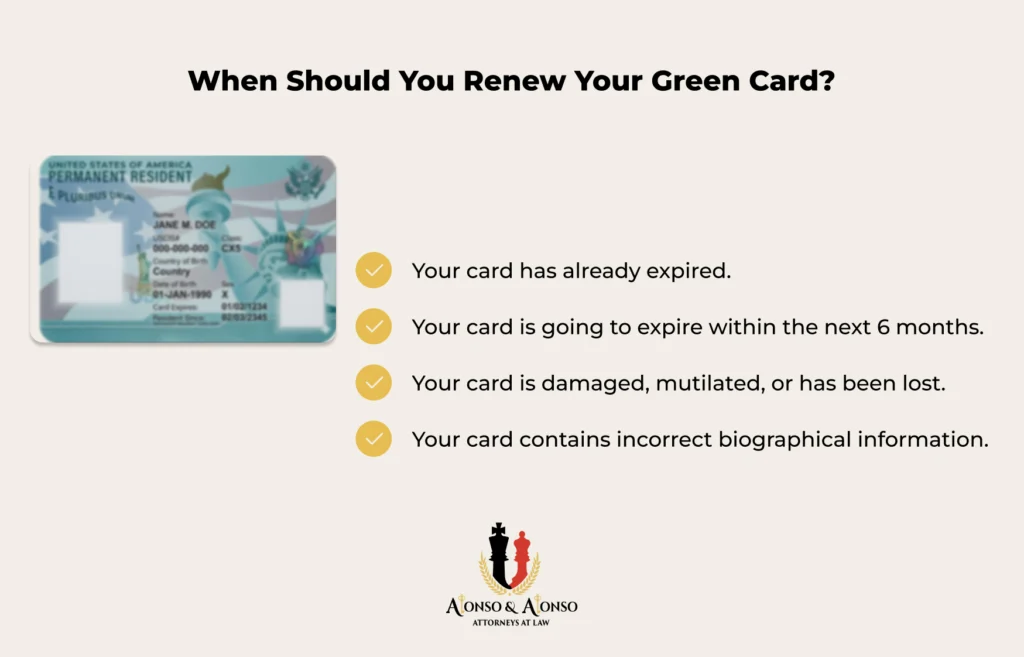
You must take action to renew your card if it is already expired or if it will expire within the next six months [1]. It is crucial not to file your application more than six months before the expiration date, as U.S. Citizenship and Immigration Services (USCIS) may reject your application and not refund your payment. Older versions of the green card are no longer valid, so it is important to check the expiration date to ensure you have a longer valid card.
An expired card does not revoke your permanent resident status, but it does prevent you from being able to prove it. Failure to carry your current green card as proof of lawful status is a violation of immigration law and can lead to complications. The fee for renewing a Green Card is non-refundable, regardless of the outcome of the application.
When to Renew If You Are Outside the United States
- If your card expires within 6 months, but you will return before it expires: You should file your renewal application as soon as you are back in the United States.
- If your card has already expired and you are abroad: Before filing any forms, you must contact the nearest U.S. consulate, international USCIS field office, or U.S. port of entry to inform them of your situation. You may need to obtain a travel document to re-enter the U.S. if your green card is expired or lost.
Actionable Steps to Renew Your Green Card
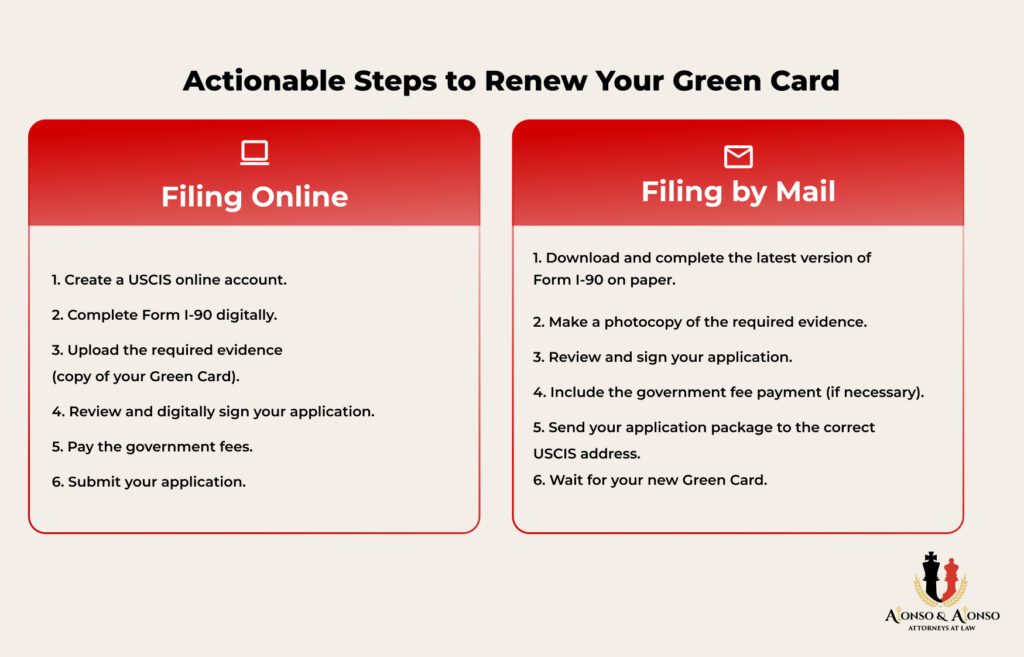
The first and most important step is to complete Form I-90, Application to Replace Permanent Resident Card [2]. Do not be confused by the word “Replace”—this is the correct form for renewing an expiring or expired 10-year Green Card [3]. You can find detailed instructions for the form on the USCIS website.
You have two options for filing your application: online or by mail. Renewing your green card online through the USCIS system is often the most convenient and efficient method. Be careful to avoid submitting the wrong form, as this can cause delays, denials, or even legal issues.
Filing Online | Filing by Mail |
1. Create a USCIS online account. This gives you a secure portal to manage your case. | 1. Download and complete the paper version of Form I-90. Ensure you are using the latest version [3]. |
2. Upload digital copies of your required documents (e.g., a copy of your Green Card). | 2. Make clear photocopies of your required documents to include with your application. |
3. Review your application and provide a digital signature. | 3. Carefully review your application and physically sign it in all required places. |
4. Pay the fees electronically using a credit/debit card or bank withdrawal. | 4. Include payment via check, money order, or by completing Form G-1450 for credit card payment. |
5. Submit your application through the online portal. | 5. Mail your complete application package to the correct USCIS lockbox facility. Use the postal service (USPS) or a reliable courier like FedEx, UPS, or DHL to ensure your documents are delivered to the correct address. |
Form I-90 and Filing Options
Form I-90 is the official application used to renew or replace your green card. You can choose to file Form I-90 online or by submitting a paper application by mail. Filing online is often faster and allows you to easily upload supporting documents and track your case through a secure USCIS online account. However, if you need to include additional documents or request a fee waiver, you may prefer the paper application.
No matter which option you choose, always use the latest version of Form I-90 and carefully follow the instructions to avoid mistakes. Double-check that you have included all required supporting documents to prevent delays in your green card renewal process.
Documents Needed for Renewing Your Permanent Residency Card
For a standard renewal, you will typically only need to provide a copy of your current Permanent Resident Card. If your card was lost, stolen, or damaged, or if you have legally changed your name, additional documentation will be required. In cases of a legal name change, you may need to provide a marriage certificate or a court order as supporting documents. Sometimes, alien documentation such as an ADIT stamp may be needed as proof of your legal permanent resident status. Conditional residents must submit the correct forms and supporting documents to remove conditions before their conditional green card expires in order to maintain lawful status.
Green Card Renewal Costs and Timeline
Filing Fees
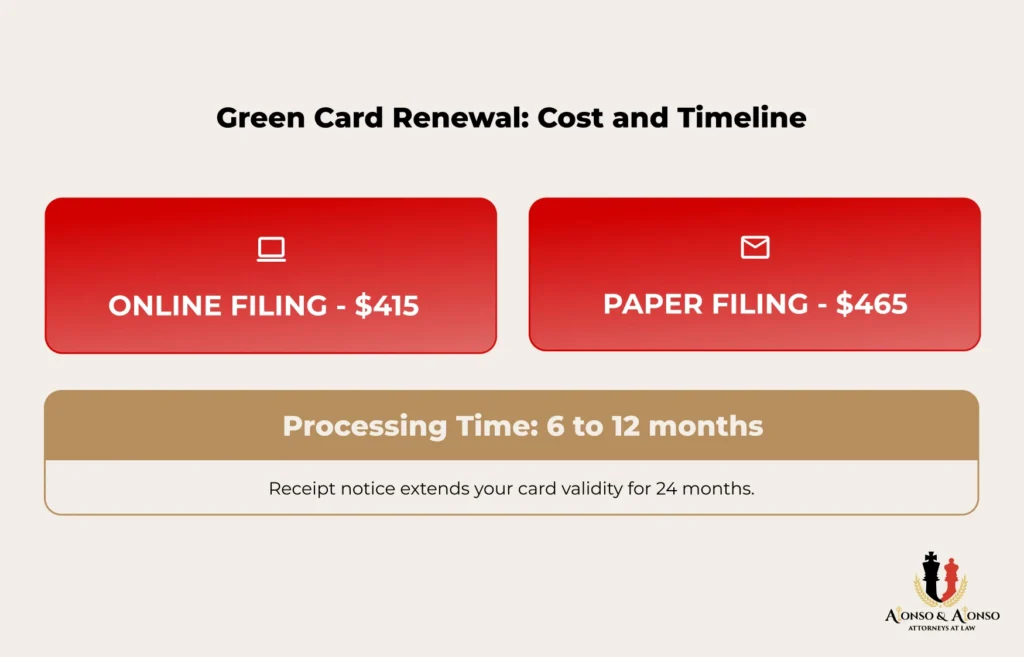
As of December 2025, the government filing fee for Form I-90 is $465 for a paper filing and $415 for filing online. If you cannot afford the fee, you may be eligible to file a fee waiver request, which requires you to file by mail. It is recommended to check the USCIS fee calculator to get the exact fee you will need to pay.
Processing Time
Once USCIS receives your application, processing can take anywhere from a few months to over a year. Renewing your Green Card typically takes approximately 6 to 12 months. Processing times may vary depending on which USCIS office is handling your green card renewal application. You can check the most current processing time estimates on the USCIS website. We provide additional guidance and updates on our Education and Resources page.
Urgent Needs: The ADIT Stamp
If you have an urgent need to prove your status while your renewal is pending—for example, for a new job or emergency travel—you may be able to obtain a temporary stamp in your passport called an ADIT stamp. You can request this by contacting the USCIS Contact Center.
What to Expect After You File Your Application

New Receipt Notice:
USCIS will mail you a new receipt notice confirming they have received your green card renewal application. This notice includes a receipt number and details about the extension of your expired Green Card’s validity for 24 months, serving as temporary proof of your status.
Biometrics Appointment Notice:
Several weeks after filing, you will receive a biometrics appointment notice. This formal document provides the date, time, location, and preparation requirements for your biometrics appointment, where USCIS will capture your fingerprints, photograph, and signature. You will receive a biometrics appointment notice 4 to 6 weeks after filing your application.
Tracking Your Green Card Renewal Status:
You can use the receipt number from your new receipt notice to check your green card renewal status online through the USCIS website and receive updates about your application’s progress.
Application Status and Updates
After you submit your green card renewal application, you can monitor your case status online using the receipt number provided by USCIS. If you filed online, you’ll receive updates and notifications directly in your USCIS online account. If you filed by mail, USCIS will send important notices to your mailing address.
It’s essential to keep track of your green card renewal application and respond promptly to any requests for additional information or evidence. You must update your address with USCIS if it changes during the processing of your application. You can also visit the USCIS website to check current processing times for green card renewals, helping you plan ahead and stay informed throughout the renewal process.
New Green Card and Next Steps
Once you receive your new green card, take a moment to review it carefully and make sure all your personal information is correct and up to date. If you notice any errors or discrepancies, contact USCIS right away to request a correction. Your new green card will have a new expiration date, so be sure to make a note of it and set reminders for future renewals.
It’s also important to update your records with your new green card information. Notify your employer, bank, and any other relevant institutions to ensure your records reflect your current lawful permanent resident status. By taking these steps, you’ll maintain your legal status, avoid future issues, and enjoy the security that comes with having a valid green card as a permanent resident of the United States.
What If Your Renewal Application Is Denied?

Receiving a denial can be frightening, but it is not the end of the road. It is a challenge that must be met with strength and strategy. USCIS may deny a renewal for reasons such as the discovery of a past criminal conviction, evidence of fraud on a past application, or submitting the incorrect form.
If your application is denied, USCIS will send a letter explaining the reasons. If you believe they made a mistake, you can file a motion to have them reconsider the decision. This is a critical moment where having an experienced legal team is your strongest shield. Our team at Alonso & Alonso has fought and won for clients in complex situations, and we are prepared to defend your future.
Frequently Asked Questions
Do I need an interview for a Green Card renewal?
Generally, an interview is not required for a simple renewal. However, USCIS always reserves the right to request an interview to verify your information.
Will USCIS check my criminal history when I renew?
Yes. Your biometric information will be used to conduct a thorough background check. Certain criminal convictions can make you ineligible for renewal and, in some cases, could even place you at risk of deportation. Do not hide from your past; let us help you confront it with a powerful legal strategy.
Is this the same process for a 2-year conditional Green Card?
No. This renewal process is only for lawful permanent residents with a 10-year Green Card. If you have a 2-year conditional Green Card, you must file a different form (Form I-751 or I-829) to remove the conditions on your residence [4]. This is a completely separate and more complex process.
Do I need a lawyer to renew my Green Card?
While you are not required by law to have an attorney for a simple renewal, attempting to navigate this process alone can be a risk. This is especially true if you have a criminal record, past immigration violations, or have spent a significant amount of time outside the U.S. An experienced immigration lawyer ensures your application is filed correctly, avoiding costly delays and protecting you from potential dangers.
Your future in the United States is worth defending. Do not let paperwork or fear stand in your way. Take the first step toward securing your peace of mind.
Follow us on social media to stay informed and send us your questions, never be left with a doubt.
Christopher Alonso
Vanessa R. Alonso
