

The Violence Against Women Act (VAWA) is a law that protects you if you are an immigrant who has experienced or is experiencing abuse by a U.S. citizen or lawful permanent resident. This law understands that living with abuse is hard enough – and your immigration status should not keep you trapped in a dangerous situation. VAWA provides an opportunity to self-petition for legal status, which means you can apply for lawful permanent residence status on your own, without help from the abusive family member. The goal is to give survivors a way to escape violence and work toward safer, more independent lives in the United States.
VAWA’s protections are not only for women; male spouses, children, and even parents of abusive U.S. citizens may meet eligibility requirements. Applying under VAWA isn’t always simple. United States Citizenship and Immigration Services (USCIS) will need certain evidence that you meet the requirements.
An experienced VAWA immigration lawyer will know how much evidence is necessary to present a winnable case and will remove as much stress from the immigration process as possible. With the right support, survivors can focus on safety and healing, not struggling through confusing paperwork alone.
Key Takeaways
Purpose of VAWA:
The Violence Against Women Act (VAWA) protects immigrants experiencing abuse by a U.S. citizen or lawful permanent resident, allowing them to self-petition for legal status without the abuser’s involvement.
Broad Protection:
VAWA is not only for women; it also protects male spouses, children, and parents of abusive U.S. citizens.
Key Benefits:
VAWA offers independence from abusers, work authorization, a path to permanent residency (Green Card), protection for children, and confidentiality.
Eligibility Requirements:
To self-petition, applicants must demonstrate a qualifying relationship, proof of abuse, U.S. residency (with exceptions), good moral character for the past three years, and that the abuser is a U.S. citizen or LPR.
Documentation is Crucial:
A comprehensive set of documents is needed, including identity documents, relationship evidence, abuse evidence (police reports, medical records, witness letters, photos), and good moral character evidence (background checks, tax returns, community letters).
Special Situations:
VAWA has specific provisions for divorced individuals (if divorce is within 2 years of filing and connected to abuse) and those in removal proceedings (requiring 3 years physical presence, good moral character, and extreme hardship if removed).
Application Process:
The process involves gathering documentation, completing Form I-360, submitting supporting evidence, filing concurrent applications (if eligible for adjustment of status, work authorization, or travel documents), attending biometrics appointments, and potentially interviews.
Legal Assistance Recommended:
The process can be complex, and seeking help from an experienced VAWA immigration lawyer is highly recommended to navigate the requirements and maximize the chances of approval.
No Police Report Required:
It is important to note that a police report is not a mandatory requirement for VAWA eligibility; other forms of evidence can be sufficient.
Criminal Record:
A criminal record does not automatically disqualify an applicant, though it may complicate the process.
Abuser Threats:
If an abuser threatens to call immigration, it can be used as evidence to support a VAWA self-petition, and seeking confidential legal help is advised.
Children Inclusion:
Unmarried children under 21 can be included in a VAWA self-petition.
Key VAWA Benefits for Immigrants
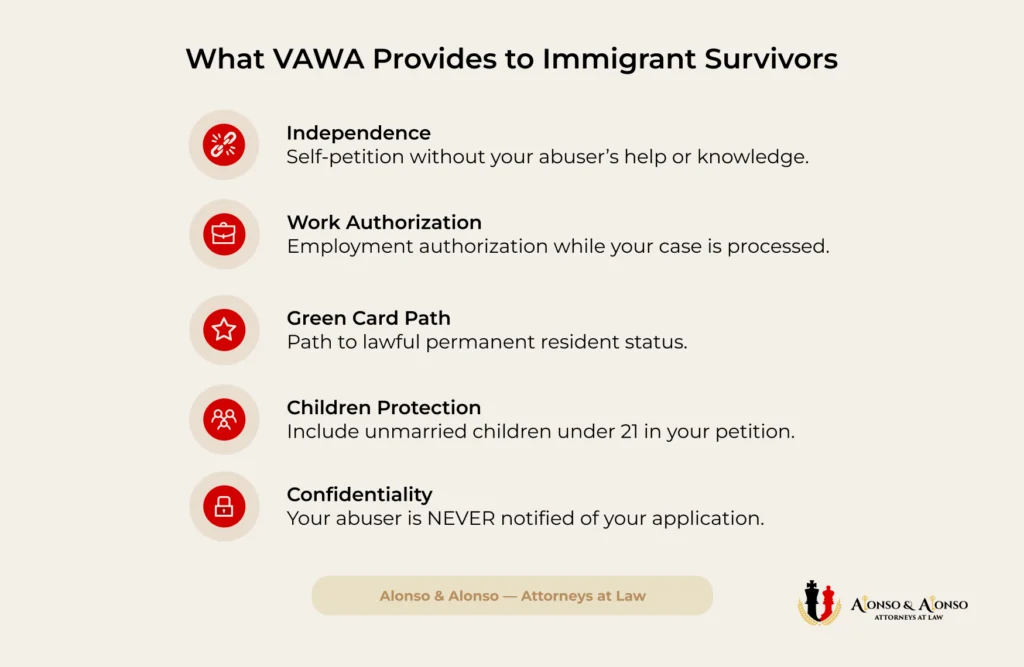
If you are an immigrant experiencing abuse from a spouse or family member, the Violence Against Women Act (VAWA) provides important protections. VAWA helps people find safety and control over their own future, even when their immigration status feels uncertain. Here are some ways that VAWA can support immigrant victims:
Independence from Abusive Family Members
You can apply for immigration relief by yourself. You do not need your abuser’s help or approval to file for lawful permanent resident status. This step lets you seek safety without them knowing and without you depending on them to initiate, sign, or cooperate in the process.
Employment Authorization
VAWA lets you ask for authorization to work legally in the U.S. while your case is being processed. This means you can start earning money and supporting yourself and your children sooner.
Path to Permanent Residency/Green Card
If you receive approval under VAWA, you may apply to become a lawful permanent resident (also known as getting a Green Card). This offers a more secure future in the United States.
Protection for Children
When you file a VAWA petition, you can include your children if they are unmarried and under 21 years old. This helps keep families together and protected.
Confidentiality
Immigration officials cannot tell your abuser about your application. Information you provide is kept private to ensure your safety. This also prevents your abuser from suffering consequences from your application unless you present evidence of a crime being committed against you.
Who Does VAWA Protect?
The Violence Against Women Act is a federal law that helps certain immigrants who have been abused. You do not have to stay with an abuser or rely on them to get a green card. You are also not obligated to separate or divorce your abuser to be eligible. VAWA gives applicants the chance to file a petition on their own. The law covers the following groups of people:
Abused Spouse
If you are married to a U.S. citizen or a legal permanent resident and your marriage was in good faith, you can qualify. This is true for both female and male spouses who have experienced abuse. In some states, common law marriages are also applicable.
Children Suffering Extreme Cruelty
The law also helps children under 21 who were harmed by a parent who is a U.S. citizen or permanent resident.
Parents Abused
Parents can qualify, too, in some situations. If your adult child, who is at least 21 and is a U.S. citizen, hurts you, the law could protect you.
If you fall into any of these groups, you may have protection and a way to apply for lawful permanent resident status without the help of your abuser. If you think your situation fits, speak with an immigration lawyer who understands VAWA immediately.
VAWA Self-Petition Requirements Checklist
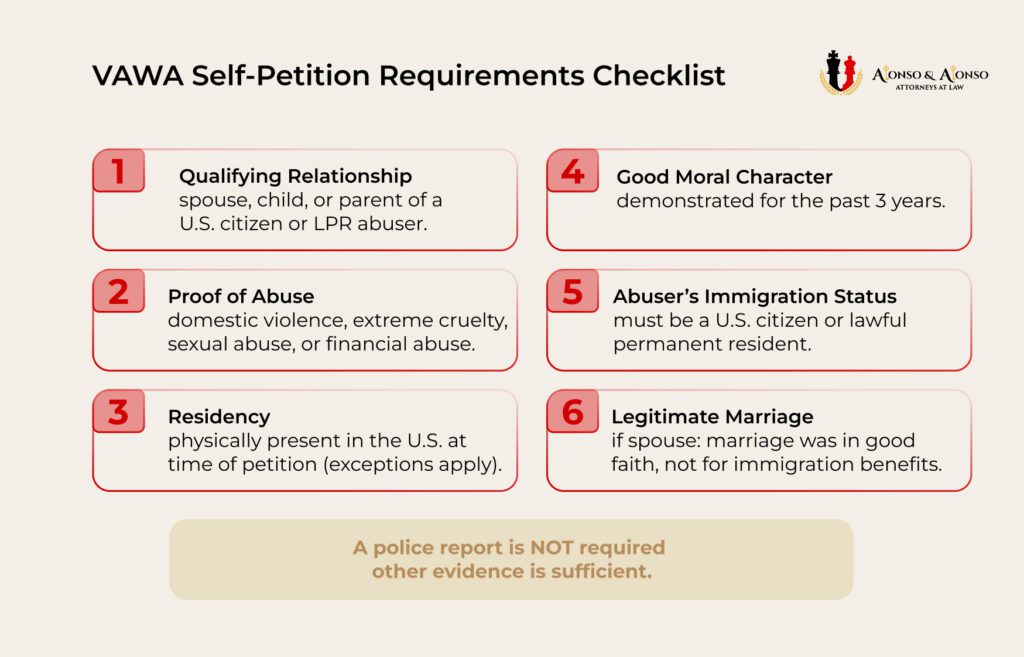
Anyone hoping to self-petition under the Violence Against Women Act (VAWA) should know that certain steps must be met to apply. This process can help victims of domestic violence, sexual violence, battery, extreme cruelty, humiliation, or financial abuse secure legal immigration status without having to depend on an abusive U.S. citizen/lawful permanent resident spouse or abusive lawful permanent resident parent.
The main requirements are below. Consider this a starting checklist if considering a VAWA self-petition.
1. Qualifying Relationship
Your relationship to the abuser must be eligible under the law:
- Spouse: Your abusive partner is a U.S. citizen or lawful permanent resident, or was during the marriage. A current or former spouse can file a VAWA petition even if their spouse lost citizenship or their lawful permanent resident status was legally terminated as a result of domestic abuse. If the applicant has divorced their abuser, then the application is only valid if the divorce occurred less than 2 years ago.
- Child: An abused child of a citizen parent or lawful permanent resident parent can also submit a VAWA self-petition.
- Parent: Parents abused by a U.S. citizen child over 21 years old may qualify in many situations.
2. Proof of Abuse
Applicants must show they suffered domestic violence, extreme cruelty, humiliation, financial abuse, or sexual abuse at the hands of the qualifying family member.
3. Residency
VAWA applicants usually must live within the U.S. at the time of petition, though there might be exceptions. If you are filing your VAWA petition from outside the United States, you must show, on top of other eligibility rules, that the abusive U.S. citizen or Green Card holder is working abroad for the U.S. government, serving in the U.S. military overseas, or that the abuse happened while you were in the United States. If approved, the self-petitioner can apply for an immigrant visa to enter the US as a lawful permanent resident.
4. Establish Good Moral Character
VAWA self-petitioners must prove that they have good moral character to be approved. This must be shown for the last 3 years. You can include tax returns or statements from community members who can vouch for your character.
5. Abuser’s U.S. Immigration Status
Proof must exist that the abuser has U.S. citizenship or is a lawful permanent resident, except in cases where the abusive spouse lost status because of domestic abuse.
6. Marriage is or was Legitimate (if Spouse)
A qualifying marriage existed (no fraud). Divorce does not necessarily bar your petition.
Documents Needed to File VAWA Petitions

Planning your VAWA self-petition means you’ll need to show evidence and meet each requirement for lawful permanent residency. Immigration officials will review these applications and all supporting documents submitted. Below is a more comprehensive look at what you’ll need when you’re preparing your VAWA petition:
Identity Documents
You need paperwork to prove both your own identity and your relationship with a permanent resident or citizen. This could include:
- A valid passport for identification
- A birth certificate for you and any children on your petition
- Marriage certificate if married to a resident or U.S. citizen
- Signed, final records from any divorces
- Death certificates for former spouses
Relationship Evidence
Building the case that you had a legitimate relationship with your spouse, or proving that you are related to an abusive parent or child, is essential. Some ways to do this include providing:
- Joint lease or property deeds reflecting shared homes
- Bank account statements or insurance policies listing you both
- Taxes jointly filed as spouses or parent/child
- Travel histories or photographs placing your family together over time
- Messages and emails between you and your abuser to show what type of relationship existed
Domestic Abuse Evidence
You’ll have to submit proof that domestic violence or extreme cruelty occurred. Documentation supports claims of physical abuse, economic harms, or emotional mistreatment. This often includes:
- Police reports describing a domestic violence incident or ongoing behavior (though this is not a requirement – you can still file even if you never called the police)
- Medical records showing you received care for abuse-related injuries, sexual assault, or psychological harm
- Letters from social workers, school counselors, clergy, therapists, legal aid, or others who know about any domestic violence incidents perpetrated by your citizen or lawful permanent resident spouse
- Photos documenting any injuries, property damage, or household damage
- Court records showing a restraining or protective order due to an abusive relationship
Good Moral Character Evidence
All self-petitioners aiming for lawful permanent residence also need proof of good character and solid community participation:
- FBI and state/local police background checks, with no major criminal convictions
- Recent tax records, a minimum of three years
- Proof of employment, if applicable
- Reference letters from anyone in the community who can confirm that you are a good community member
Having the right documents supports your story and gives immigration services a well-organized application. An experienced immigration lawyer can help you get evidence and forms together, which can reduce delays and give you a better chance of being approved.
With decades of experience handling VAWA cases, Alonso & Alonso Attorneys at Law knows how to give your application the best chance of success, even if you can’t gather all these documents. In fact, we have won cases in the past with as little as the applicant’s declaration and a psychological evaluation.
VAWA Requirements for Special Situations
Sometimes, survivors who want help from the Violence Against Women Act face extra challenges because of their personal situations. Immigration law has specific rules for people who have unique issues related to their relationships or legal situations. Below, you’ll see how certain circumstances, like divorce or being in deportation proceedings, can affect your VAWA self-petition.
VAWA Requirements for Divorced Individuals
Many self-petitioners can still file for VAWA protection even after a divorce, but you must meet a few essential requirements. If your marriage to your U.S. citizen or lawful permanent resident spouse has ended in divorce, filing is allowed as long as your divorce happens within 2 years of filing your VAWA petition.
You also need to show that your divorce was directly connected to your experience of domestic violence or abuse. Finally, a petition from a divorced person, just like from married VAWA petitioners, must still show that the relationship to your spouse was entered in “good faith,” not for the purpose of getting a green card.
VAWA Cancellation of Removal Requirements
When immigrants are placed in deportation or removal proceedings, filing for VAWA comes with more conditions. You’ll need to prove you’ve been physically present in the United States for at least three years before applying. Applicants also need to show a three-year record of good moral character. You must establish that your removal from the country would cause you to suffer “extreme hardship.”
How to Apply for VAWA: Step by Step
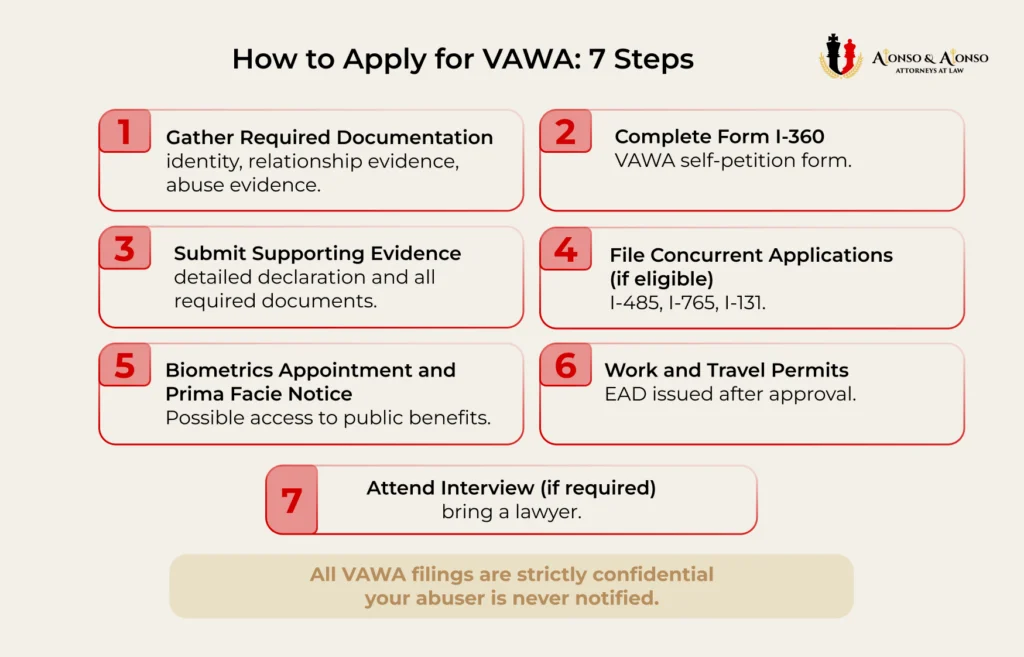
Starting a VAWA self-petition is much easier if you know how the process works and what to do.
Step 1: Gather Required Documentation
First, you should start collecting the necessary paperwork and documents proving you are eligible for relief. This might include marriage or birth certificates, proof of abuse, and proof that your abuser is a lawful permanent resident or US citizen (depending on the relationship). The more reliable evidence you have to prove that you’re a victim of domestic violence, the stronger your self-petition will be.
Step 2: Complete Form I-360
Form I-360 is the main form used to file a VAWA self-petition. It collects basic biographical information about the applicant and details about the relationship with the abusive U.S. citizen or lawful permanent resident. However, this form does not ask for information about your entries and exits from the United States or the specific dates you lived with your abuser. Those details are usually provided in your personal declaration and supporting evidence submitted with the petition.
Step 3: Submit Supporting Evidence of Eligibility Requirements
Along with your I-360 form, you’ll mail in everything you’ve gathered. The types of evidence needed depend on your relationship (citizen spouse/lawful permanent resident relative or parent), but should include facts of abuse in a detailed declaration and other requirements like identity, proof of relationship, and evidence of cohabitation with your abusive family member.
Step 4: File Concurrent Applications (if eligible)
Depending on your specific situation, you might be eligible to file concurrent applications. This might mean filing Form I-485 (to adjust status and obtain a Green Card), Form I-765 (work certification/employment authorization during wait times), and Form I-131 for permission to leave and return to the United States.
Step 5: Biometrics Appointment and Prima Facie Notice
After submitting your VAWA self-petition (Form I-360), you will typically receive a biometrics appointment where USCIS will take your electronic fingerprints to conduct a background check. If your petition meets the basic eligibility requirements, USCIS may issue a prima facie notice, confirming that your application has been initially reviewed and that there is enough evidence to believe you qualify to continue. Not all VAWA cases receive a prima facie notice, as its issuance depends on the sufficiency of the evidence provided. It is important to note that receiving a prima facie notice does not mean your case has been approved or denied. With a valid prima facie notice, you may become eligible for certain state or federal public assistance programs, such as public housing, food assistance, or victim services, depending on your state’s policies.
Step 6: Work and Travel Permits
If USCIS approves your applications, you will receive your work permit and, in some cases, a travel permit, allowing you to work legally and travel outside the U.S. with authorization while your case continues to be processed.
Step 7: Attend Interviews (if required)
Sometimes USCIS schedules interviews with VAWA self-petitioners to verify claims or request more documentation. If called to an interview, bring both original documents and copies of everything you’ve submitted. If this happens, you should always have a lawyer with you to make sure you have the best chance of success.
While this process can seem scary or confusing, many people have stood where you stand now. Being prepared with the proper documents and speaking with compassionate but aggressive immigration lawyers helps significantly.
Get Help With a Free Evaluation From a VAWA Immigration Lawyer

If you believe you qualify for protection under the Violence Against Women Act (VAWA), taking that first step and talking to an immigration law office is essential. A free evaluation with the VAWA immigration lawyers from Alonso & Alonso is an important first step. We’ll ensure you know how the process works and help you file everything properly – you don’t have to figure it out alone.
During your consultation, expect to discuss your situation, but we can do it at your own pace. We’ll answer your questions and tell you what we need from you to get started. To make things run more smoothly, try to bring documents related to your marriage or relationship, proof of residence, and any evidence of abusive behavior. We provide free initial evaluations to every potential VAWA petitioner. Remember not to disqualify yourself before speaking to us. Contact us today when you’re ready to learn more about this or any other humanitarian-based immigration process.
VAWA Requirements Frequently Asked Questions
What qualifies you for VAWA?
You may qualify for VAWA if you are or have been mistreated by a U.S. citizen or legal permanent resident spouse, parent, or a U.S. citizen adult child. Immigration’s definition of abuse is vast and covers different types of mistreatment you may have suffered.
What if my abuser threatens to call immigration?
If your abuser threatens to report you to immigration, you still have rights and privacy protections under VAWA. This kind of abuse—threats, intimidation, or control based on your status—can support a VAWA self-petition.
If you’re in danger, document the threats and seek confidential legal help as soon as possible.
Can my children be included in my VAWA petition?
Yes, unmarried children under 21 may be included in your VAWA self-petition as “derivative” beneficiaries, and if a child needs protection independently, there are also separate filing options.
Can I still apply for VAWA with a criminal record?
You can submit a VAWA self-petition even with a criminal record, though it may make the process more complicated. Our team has worked with many survivors in these kinds of challenging cases.
Do I need to report domestic violence to the police to meet VAWA requirements?
You do not need to have reported abuse to police for VAWA eligibility; evidence like medical records, statements from friends, counseling notes, letters from religious leaders, and even your own declaration may be enough to support your case.
Follow us on social media to stay informed and send us your questions, never be left with a doubt.
Christopher Alonso
Vanessa R. Alonso
