
Waiting for a U visa can be one of the hardest experiences a survivor of crime will ever face. You’ve already endured trauma, and so much uncertainty about your future in the United States just adds to the difficulty of your situation. You aren’t alone in feeling frustrated or anxious. Many U visa applicants share these same concerns as they look for safety and a chance to build a new life. So, how long does U visa processing take? The current reality is that the process is very lengthy; most applicants can expect their case to take anywhere from 5 to 10 years from filing to final decisions and approvals. Fortunately, our U visa lawyer is always here to help you.
A small but encouraging update: the Bona Fide Determination process (BFD), which gives temporary legal protection and a work permit, now takes about 35 months for 80% of applicants, down from over 64 months in recent years. If your case qualifies for BFD, you can usually expect your work permit (Employment Authorization Document/EAD) a few weeks after BFD approval.
However, for final U visa approval, United States Citizenship and Immigration Services (USCIS) is just now handling cases filed in 2017 and 2018. When you are finally granted U nonimmigrant status, you must wait an extra three years before becoming eligible to apply for your green card, adding even more time to your overall U visa application process.
This guide will walk you through each stage of U visa processing as it currently stands, highlight 2025’s updates and improvements, and let you know what to expect in 2026. You’ll find out how to protect your application while it’s pending and what happens as you move from U visa status to lawful permanent residence (green card).
Key Takeaways:
Long Processing Timelines:
The total time from filing your petition (Form I-918) to final U visa approval is approximately 5–10 years due to the annual cap and massive backlog of applications (180,000–250,000+ pending cases).
Interim Relief (BFD) is Faster:
The Bona Fide Determination (BFD) process, which grants temporary protection and a work permit, currently averages 35 months (median for 80% of cases), a significant improvement from previous years.
Work Permit (EAD) After BFD:
After BFD approval, your 4-year Employment Authorization Document (EAD) is supposed to be issued within 2–8 weeks, but given the current backlog USCIS is experiencing adjudicating U visa cases, the EAD can last several years in some cases.
Final Approval Wait:
Even after BFD, final U visa approval takes an additional 24–36 months as your case waits for one of the 10,000 annual visa numbers to become available. USCIS is currently processing cases filed in 2017–2018.
Path to Green Card:
You must maintain U status for a minimum of 3 years before you can file for a green card (Form I-485). Green card processing then takes an additional 18–36 months.
Key to Avoiding Delays:
A complete and strong application, especially a clear and valid law enforcement certification (Supplement B), minimizes the risk of Requests for Evidence (RFEs), which can add 3–12 months to the timeline.
Protect Your Case:
You must keep your address updated (file Form AR-11 within 10 days of moving) and maintain cooperation with law enforcement throughout the entire process to prevent case denial or delays.
Understanding the U Visa: Quick Overview
The U Visa is a special nonimmigrant status for victims of certain serious crimes who have suffered substantial physical or emotional harm, and who are willing to assist law enforcement in investigating or prosecuting those responsible.
Qualifying Crimes and Who Qualifies
You may qualify for a U visa if you are the victim of a qualifying crime such as domestic violence, sexual assault, human trafficking, stalking, or kidnapping. To be eligible, you need to have helpful information about what happened and you must currently be helping, have helped, or be willing to help law enforcement. Showing substantial harm, meaning physical or mental abuse from what you went through, is also required.
Why U Visa Application Processing Takes So Long
There is an annual cap of only 10,000 principal U visas issued each year, which is much lower than the number of people applying for protection. With a massive U visa backlog, often between 180,000 and 250,000 cases, applications move through a first-come, first-served system, leading to a U visa waiting list and wait times that easily stretch into several years. It can also vary depending on the waitlist type, overall USCIS processing times and availability.
U Visa Processing Time 2026: Complete Timeline Breakdown
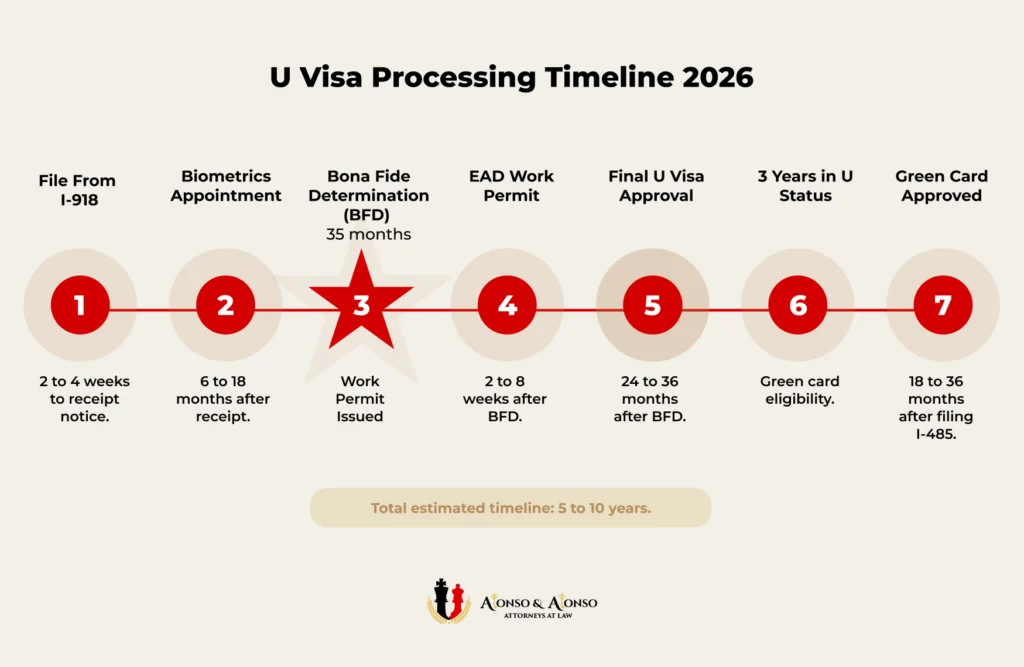
Below is a step-by-step look at what happens at each stage of your U visa journey in 2026, approximate time frames, and actions you should take to keep your case on track.
Filing to Receipt Notice (2-4 weeks)
Once you file your I-918 package, USCIS usually mails a notice of receipt within about 2 to 4 weeks. Save this document, set up your USCIS online account, and make sure your address stays current with USCIS so you never miss an update.
Receipt to Biometrics Appointment (6-18 months)
After your receipt, the next big step is scheduling your fingerprinting (biometrics). This process now averages 6 to 18 months. Attend your appointment and keep documentation for your records; watch your mail and online account for updates.
Biometrics to Bona Fide Determination Process (BFD) (35 months)
USCIS then reviews if you qualify for interim relief, leading up to an official BFD. This review averages about 35 months for most cases. Respond to any Request for Evidence (RFE) you receive as soon as possible, and keep law enforcement contacts up to date if asked.
BFD Approval to Employment Authorization (EAD) (2–8 weeks)
Shortly after you’re approved as “bona fide,” you can receive a work permit valid for up to four years. Most people are issued the document within a few weeks of BFD approval. Apply for your Social Security Number and note the EAD expiration so you can renew it appropriately if your case drags on past the 4-year limit.
Bona Fide Determination to Final U Visa Approval (24-36 months)
After Bona Fide Determination, your U visa case waits for a visa number to become available. This can take between 24 and 36 months from BFD because of national annual limits. Use this period to gather documents and timeline info for the green card filing, which is available three years after your U status is granted.
U Visa to Green Card Eligibility (At Least 3 Years in U Status)
You become eligible to apply for permanent residency (a green card) after spending at least 3 years under U visa protection. During this time, maintain a clean record, keep proof of all locations/residences, and prepare your documents.
Green Card Application Processing (18-36 months)
Once you become eligible for a green card, filing Form I-485 and being approved will take about 18 to 36 additional months. You may be called for an interview, so complete any additional medical exam requirements and respond quickly to evidence requests. After you’ve received your green card, you may eventually be eligible for United States citizenship as well.
2024 vs 2025 Processing Time Improvements
The timeline for collections of “bona fide” work permits has improved from more than 5 years just one cycle ago to under 3 years for most families now. Keep an eye out as USCIS hiring, better technology, and new processes have made reviews go (modestly) faster in 2025 compared to recent years. This gives us hope that 2026 will be the same, and hopefully faster.
The process is extensive and can take a long time, but having the proper documents and legal help at every stage puts you in the strongest position for success and future security in the United States.
U Visa Processing Time After Biometrics: What to Expect
After you finish your biometrics appointment, your case enters a long waiting period, but understanding what happens next makes it easier to plan for the future.
What Happens at the Biometrics Appointment?
At your appointment, USCIS collects your fingerprints and takes a photo, which are then used for FBI and security background checks. This step also updates your picture in the USCIS system and double-checks your true identity, safeguarding against fraud and data errors.
What Biometrics Completion Means (and Doesn’t Mean) For Your U Nonimmigrant Status
Going through biometrics means your case is officially advancing in the process, but it’s not a sign of quick approval. You can expect to wait 6 to 24 more months for these clearances, depending on case complexity.
Timeline After Biometrics
Once your background check begins, most family members see it completed within 6-24 months. After this part wraps up, the next focus is Bona Fide Determination (‘BFD’), which can take anywhere from 18 to 35 months from your original biometrics date. During this time, USCIS may issue a Request for Evidence (RFE) requesting additional documents or answers if questions arise about your history or eligibility.
What You Should Do After Biometrics
Be sure to keep the biometrics appointment notice. Set alerts to frequently check your USCIS case history online for updates or notices, and look out for any RFEs or requests so you don’t miss critical deadlines. Update USCIS if you move or change contact info, and keep communication lines open with law enforcement in your case.
U Visa Bona Fide Determination (BFD) Processing Time
Reaching the Bona Fide Determination (BFD) stage represents a positive turning point in the U visa process while you wait for final approval. Added in June 2021, BFD offers special interim relief, allowing some benefits even before your actual U visa is granted. While BFD isn’t a guarantee that your petition will be approved, it’s a strong and encouraging sign that your case has met important requirements.
Current BFD Processing Time (2025/2026)
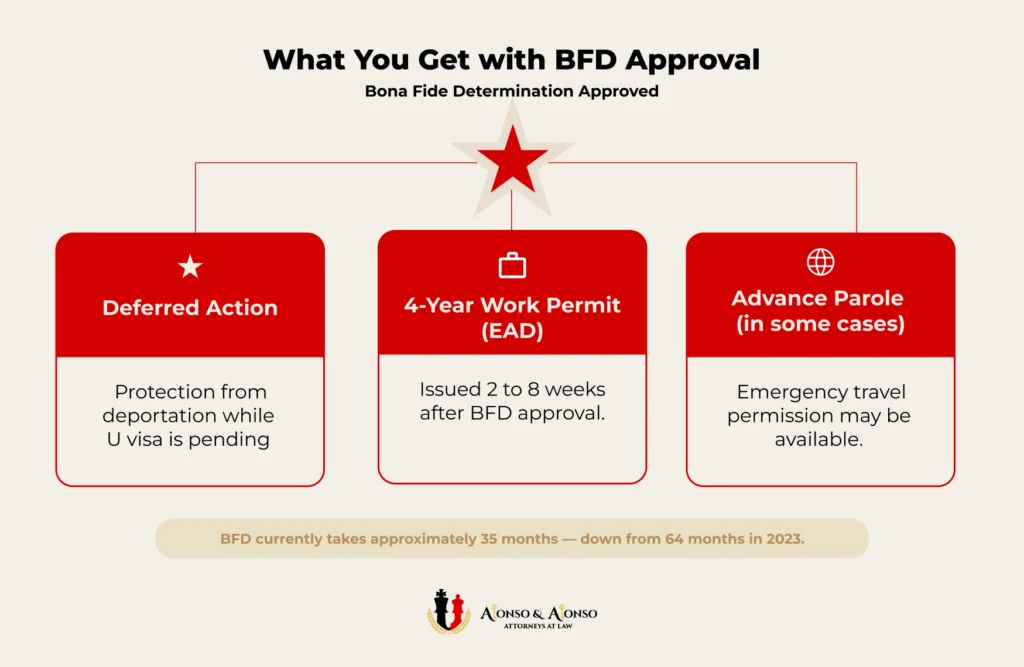
As of 2025/2026, the typical processing time to get a BFD was about 35 months for 80% of applicants. This updated timeline shows progress compared to 2023, when family members regularly waited over 64 months just for BFD review. Be aware that the processing time still depends on the service center handling the case and on individual case details or background check delays.
What You Get with BFD Approval
A granted BFD brings important benefits. You may receive “deferred action,” which is protection from deportation while your U visa is pending. You are also issued a four-year work permit (EAD) and, in some situations, may become eligible for advance parole (travel permission). You can renew the work permit if your U visa hasn’t been finalized when that four-year period ends.
BFD Eligibility Requirements
To reach this milestone, your U visa package needs to be thorough. The forms must be complete and accurate, including your personal I-918 application, a detailed police or law enforcement certification (Supp. B), and sufficient supporting evidence. USCIS will check your criminal history and conduct background and security reviews. You also have to demonstrate substantial harm from the crime.
What If BFD Is Not Granted?
If your petition isn’t found bona fide, you won’t be eligible for work authorization or deportation relief at this time. Your case likely stays on the regular waitlist until the final review process. In such cases, USCIS may send a Request for Evidence (RFE) or a Notice of Intent to Deny (NOID), giving you one more shot to explain missing pieces or clear up doubts.
If this happens, getting immediate advice from an immigration lawyer is crucial to preserving your rights and giving your case its best possible chance of a future BFD and eventual U visa approval.
U Visa Work Permit Processing Time (EAD)
Receiving work authorization is a milestone for many U visa applicants, providing financial independence and some peace of mind while waiting for final case approval.
How U Visa Work Permits Work in 2026
Work permits for U visa applicants are issued upon BFD approval. To start this process, you file Form I-765, either together with your original I-918 petition or on its own afterward if you missed it at the start. Authorization is not automatic just for applying for a U visa.
U Visa EAD Processing Time
After your case receives BFD status, you can expect to receive your physical EAD card in about 2 to 8 weeks, and the BFD can take up to 35 months. Once issued, U visa work permits are generally valid for 4 years.
Work Permit Renewal While U Petition (Form I-918) Is Pending
If your U visa status is still unresolved before your EAD nears its expiration date, you can and should renew using Form I-765. File your renewal about 4-6 months (120-180 days) before your current card expires, attaching proof that your U visa case is still pending.
Applicants used to benefit from an automatic 180-day extension upon timely renewal, but EAD extensions generally do not apply to renewals filed on or after Oct. 30, 2025, except for limited categories; confirm current rules before filing.
What You Can Do with Your U Visa EAD
With a valid EAD, you have the legal right to work for any U.S. employer. Your card lets you apply for a Social Security Number if you don’t have one currently. In many states, you can also take your EAD to the DMV to apply for a driver’s license. Plus, it helps you to open bank accounts and establish personal credit.
Work Permit Checklist
Safeguard your EAD card – keep copies in a different location. Apply for your SSN as soon as your EAD comes. Set a 6-month advanced reminder so you never miss a renewal deadline, and always double-check your I-918’s pending status. Save proof of your wages, tax documents, and employment history because they are needed later when you apply for lawful permanent residency after your U status is granted.
U Visa to Green Card Processing Time
Transitioning from U visa status to lawful permanent residency (a green card) is a multi-year journey that offers safety and new opportunities for survivors of certain qualifying crimes.
Eligibility for Green Card After U Visa
You must have held U status for at least three continuous years while physically present in the United States. Continued cooperation with law enforcement, if asked, also remains a requirement. Applicants must not have engaged in any serious criminal activity since their U visa was granted. Generally, you must also demonstrate that receiving a green card is justified due to humanitarian needs, the best interests of family unity, or because it serves the public interest.
U Visa Adjustment of Status Processing Time
After you reach that three-year U status mark, the Form I-485 green card applications have generally been taking about 18 to 36 months to process in 2025, with the same expected in 2026. Another biometrics appointment is scheduled, usually six to 12 months after you apply. Depending on your case and local USCIS workload, you may be called in for an interview between 12 and 24 months after filing. In total, expect about a year and a half to three years from filing to receiving your green card.
Step-by-Step: U Visa to Green Card Timeline Make sure you take the following steps:
Year 0–3: Maintain your U visa and record every day you spend in the U.S.
Year 3: Once eligible, prepare and file Form I-485 with supporting documents and a new medical exam.
Year 3–4: Attend all biometrics appointments and background checks as USCIS schedules them.
Year 4–5: Go to any requested interview; keep correspondence with USCIS open.
Year 5–6: Final approval and green card issuance.
What “Continuous Physical Presence” Means
Applicants need at least three years of physical presence after U visa approval. Brief travel abroad is sometimes permitted with advance parole, but long or repeated absences can interrupt the process and lead to delays. Always talk to a lawyer before traveling outside the U.S.
Green Card for U Visa Family Members (Derivatives)
Qualifying family relationships can lead to derivative U status. This could include spouses, children, or, in certain cases, parents of the principal applicant. Each derivative family member must have three years of continuous presence and can file their Form I-485 separately or together with the principal applicant.
Factors That Affect U Visa Processing Time
The wait for U visa approval can vary widely from one applicant to another. Processing times depend on a combination of the quality of your application, background check results, USCIS workload, and your continued attention to correspondence as your case moves forward.
Application Completeness and Quality
A well-prepared application makes a big difference. Strong law enforcement certification (Supplement B) should be complete, signed by someone authorized, and provide specific, detailed descriptions of your cooperation. Your personal statement describing what happened to you, why you need help, and the harmful effects you’ve endured should be clear.
Submitting thorough evidence, such as police records, psychological or medical documents, and supporting affidavits, gets your application taken seriously. Be meticulous about filing every required form (I-918, Supp. A if needed, I-765 for work permit, and all filing fees and photos).
Background Check Complications
U visa background checks are extensive. If you have prior immigration violations or even minor criminal offenses, security reviews may take longer. Applicants who have lived in several countries can expect international records to cause further delays, and security systems sometimes confuse similar names, creating unnecessary checks or delays.
Requests for Evidence (RFE)
If something is missing, or USCIS thinks Supplement B is incomplete or the evidence of your harm isn’t convincing, they’ll send an RFE. They may ask for medical proof, a more in-depth letter from law enforcement or details confirming your helpfulness in an investigation or prosecution. Any RFE stretches out your timeline, frequently adding 3 to 12 extra months before your case moves forward again.
Service Center Workload
Nearly all U visa petitions are reviewed at the Vermont Service Center, but its caseload can ebb and flow dramatically. How quickly things move will reflect whatever U visa backlog and staffing issues that office is juggling at the time.
Address Changes and Missed Notices
Failing to update your address when you move can be disastrous. Criminal background checks can return incorrect results, and urgent RFEs or interview notices might not reach you. In a worst-case scenario, missing official correspondence leads to denied or closed cases. Be sure to submit Form AR-11 for every new address and update your USCIS online account whenever you relocate.
How to Check Your U Visa Case Status

Staying informed about the progress of your U visa case is essential to avoid missing urgent requests or approval updates. Here’s how to track your case:
Use the USCIS Online Case Status Tool
Go to the USCIS Case Status Online page and enter your 13-character receipt number from your receipt notice. View immediate updates about your application’s stage, any Requests for Evidence (RFEs), and decisions.
Create a USCIS Online Account
Visit myUSCIS. Link your receipt number to your new account for detailed case monitoring. This lets you opt for email or text alerts on status changes, and you can view and download copies of USCIS notices as soon as they’re available.
Check the USCIS Processing Times Tool
Go to USCIS Processing Times. Select “Form I-918” and your specific service center to view the latest processing timelines. Remember that quota backlogs mean these posted ranges may be less useful for long-delayed U visas.
Contact USCIS Directly
If your case is outside the normal posted time, or you’re waiting for an important notice, call the USCIS Contact Center at 1-800-375-5283 (TTY: 1-800-767-1833). Be ready to provide your receipt number and verify your personal details to check eligibility or get personalized assistance.
When to Contact an Immigration Attorney
Get legal assistance from a qualified immigration attorney if you receive an RFE or NOID, never get an expected notice, your case stretches far past average timelines, or you need help updating your contact information or fixing an application error.
What to Do While Waiting for Your U Visa
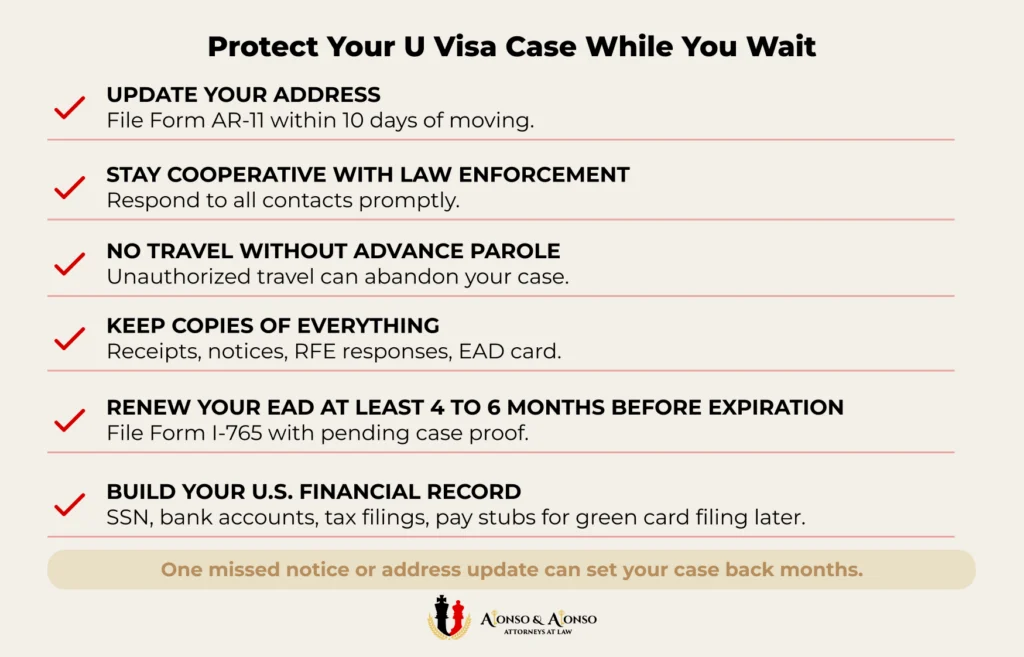
While waiting for your U visa, there are important steps you should take to protect your case and stay prepared for each milestone.
Protect Your Case
Make sure you file Form AR-11 with USCIS within 10 days of moving to a new address; missing this could result in missed notices and delays. Keep copies of everything you send or receive, from receipts to notices. If you get a Request for Evidence (RFE), respond as soon as possible (not just at the deadline), and remain available for any law enforcement cooperation if needed.
Document Your Case Continuously
Continue therapy or counseling, and track your progress in case notes to directly support your claim of ongoing harm. Document any threats, emotional impact, or new cooperation with the police. Stay connected with victim advocates or support staff, as you might need letters from them as you move forward.
Avoid Actions That Could Harm Your Case
Stay away from any criminal activity, no matter how minor the offense may seem. Do not travel outside the U.S. unless you’ve been granted advance parole; unauthorized travel may result in USCIS considering your request abandoned. Only work with a valid Employment Authorization Document (EAD), and never submit false or altered information during your case.
Plan for the Future
Apply for a Social Security Number as soon as you get your EAD. Find out what paperwork and tests are needed to get a state I.D. or driver’s license after you are eligible, and begin building your U.S. financial history – credit cards, bank accounts, pay stubs, and tax filings all help when it’s time to apply for a green card. Begin organizing personal documents for your next application as well.
Get Support
Leaning on the community can make the wait easier. Reach out to victim services, support groups, or trauma counselors for emotional guidance and extra documentation for your U case. Make sure to periodically check in with your lawyer for any updates or new strategies relevant to changing laws or office procedures.
Can I Travel or Get a Driver’s License While Waiting?
Understanding the rules on what you can and can’t do while your application is being processed is essential.
Travel During U Visa Processing
It is almost never recommended to leave the United States while your U visa is pending or before BFD approval; doing so could result in your application being considered abandoned. If you reach BFD, you may apply for advance parole for emergency travel, but always consult your attorney first. Once final U visa approval is granted, some travel becomes easier, but threats like denied re-entry, three or ten-year bars, or other legal complications always carry serious risk. Always. talk to your lawyer before traveling.
Driver’s License with U Visa Status
Your ability to get a driver’s license will depend on your state. Most require your current EAD card, proof of address, and a Social Security Number (or a letter explaining ineligibility). Some states are much more lenient, while others are stricter, so always check your local DMV’s requirements before applying.
Other Benefits You May Access
Depending on where you live, a U visa or a pending case with a valid EAD could make you eligible for in-state tuition, certain state or professional licenses, and, in some cases, cash, food, or legal benefits. Always verify directly with agencies or community organizations, as rules vary by location and can change frequently.
How to Get Law Enforcement Certification (Supplement B)

To successfully apply for a U visa, you must submit Form I-918 Supplement B, sometimes called “law enforcement certification.” This form is critical, as it proves you were a victim of a qualifying crime and that you have helped or are willing to help law enforcement pursue the offender.
What Is Form I-918 Supplement B?
Form I-918 Supplement B must be signed by an authorized official, such as a police officer, investigator, prosecutor, or judge, linked directly to your case. The official’s signature on this form confirms you’ve suffered a serious qualifying offense and have either already assisted or agreed to assist law enforcement, now or in the future.
Who Can Sign Supplement B?
Police chiefs, detectives, district attorneys, prosecutors, judges, or anyone in charge at a relevant federal, state, or local law enforcement agency may sign your Supplement B. Child Protective Services (CPS) can sign in certain cases involving child abuse or neglect, and, for some crimes, authorization may extend to officials outside standard law enforcement channels.
How to Request Certification
Here’s how you can request certification from law enforcement:
Step 1: First, determine the correct agency (like a local police department, prosecutor’s office, or Family Services), and ask for contact information for the right official.
Step 2: Gather details about your case, such as report or case number, the detective’s or investigator’s name, arrest date, and the relevant crime.
Step 3: Write a clear, polite letter or email requesting the Certification on Supplement B. Briefly explain your eligibility and offer any supporting documents.
Step 4: Send the blank Supplement B form along with USCIS instructions.
Step 5: If you get no answer after two to four weeks, follow up respectfully and do not give up; persistence is sometimes necessary.
Sample Request Email Template
Subject: Request for U Visa Certification (Case #[Your Case Number])
Dear [Detective/Prosecutor Name or Title],
My name is [Your Name], and I was the victim of [type of crime] on [date]. The case number is [case number], and [detective/officer name] investigated my case.
I am applying for a U visa, which is available to crime victims who have cooperated with law enforcement. As part of my application, I need a signed certification (Form I-918 Supplement B) from your agency.
I have attached:
- Blank Form I-918 Supplement B
- Instructions for completing the form
- Copy of the police report (if available)
I have been and continue to be willing to assist with the investigation and prosecution of this crime. Please let me know if you need any additional information from me.
Thank you for your time and consideration.
Sincerely,
[Your Name]
[Your Contact Information]
What If Law Enforcement Refuses?
If law enforcement refuses to certify your Supplement B, politely request a written explanation for the denial and ask if you can speak with a supervisor or the agency’s U visa liaison. You may be able to provide extra evidence of your cooperation or get help from a victim advocate to communicate your case. Always consult an immigration attorney, as they may know which strategies or approaches to use in these situations.
Common Reasons for U Visa Delays and How to Avoid Them
Even a small misstep can set your U visa back several months or even years. Some common reasons for delays include:
Incomplete or Weak Evidence Package
Missing items, unclear personal statements, or failing to establish the right kind of harm are the most frequent causes of slowdowns. Work closely with an experienced U visa attorney to ensure all medical records, therapy documentation, police reports, and witness affidavits are included in your initial submission.
Unclear or Insufficient Supplement B
Make sure your certifications are thorough, complete, and signed by the right official. An original, clear signature and stamp can make a big difference.
Criminal History Issues
Any prior arrests or immigration violations significantly increase the time required to review the application. If possible, work with a lawyer from the start to disclose any such issues, obtain certified dispositions and court records, and discuss strategies or waivers to address them.
Address Changes Not Reported
Maybe the most common reason cases are accidentally closed is that claims communications are sent to an old address. File Form AR-11 and update your account whenever you move. Using your lawyer’s office address is one easy way to ensure all notifications are received.
Gaps in Cooperation with Law Enforcement
Your chances of approval go down when officers, detectives, or prosecutors tell USCIS that you stopped helping them with the case. Remain cooperative and answer or return their calls promptly.
How Alonso & Alonso Helps Strengthen U Visa Cases
Alonso & Alonso supports U visa applicants from the very start, helping immigrant crime victims avoid setbacks and increase their chances for success. Our team is hands-on and focused at every phase, ensuring your application is organized, complete, and presented as powerfully as possible.
Our U Visa Case Preparation Process
We start every case with a careful eligibility review to catch possible issues and create a plan that avoids surprises down the road. Our team works closely with you to collect and clearly organize all proof of substantial harm and evidence that will help law enforcement.
We have strong relationships with police, prosecutors, and advocates, and we coordinate these resources to pursue a timely Supplement B certification. Through careful planning and triple-checking records, we do everything possible up front to minimize Requests for Evidence and slowdowns.
Why Experience Matters
U visa petitions require close attention to changing requirements and strict documentation – a missing page, error, or confusing Supplement B can harm a case. Our attorneys know what makes for a persuasive package and stay ahead on USCIS trends and processing time changes, reducing guesswork and uncertainty.
Support Throughout the Process
Even after we submit your application, we’re routinely checking your case progress and alerting you to RFEs, interview calls, or deadlines. We also help with Employment Authorization renewals, work eligibility, advance parole travel requests, and green card plans down the line. Our goal is to offer ongoing peace of mind. Schedule a Consultation
Speak confidentially and without obligation by scheduling a consultation with Alonso & Alonso at alonsoandalonsolaw.com. We’ll talk about what’s best for you, set expectations, and personalize your entire U visa application and follow-up plan.
Navigating the U Visa Timeline with Confidence
Reaching U visa approval and lawful residency is a long process, but your patience can pay off.
Key Takeaways
The U visa process can take anywhere from 5 to 10 years due to limited visa numbers and a persistent backlog, but an Interim BFD approval (currently about 35 months for most cases) unlocks work rights several years before your U visa is final. Having a strong, complete filing up front and responding quickly to USCIS requests can save months or years of delay. Continuing cooperation with police/prosecutors and immediate address updates are critical. After three years with U status, permanent residency (a green card) is within reach.
Next Steps
Gather as much evidence as possible about the crime you experienced, injuries, and how you’ve been affected. Request a Supplement B from law enforcement right away. Review your entire plan and documents with a skilled U visa lawyer. Put together everything needed for a thorough, compelling petition, and routinely monitor status and updates along the way.
Get Expert Help from Alonso & Alonso
The process is long and emotionally draining, but you never have to face USCIS or the obstacles alone. The attorneys at Alonso & Alonso have guided hundreds of individuals and families through the system and are ready to fight for a secure future for you. Contact our immigration law firm at alonsoandalonsolaw.com to arrange a confidential review and learn more about how we can strengthen your case and shorten your journey toward safety and green card approval.
Frequently Asked Questions
1. How long does it take to get a U visa in 2025/2026?
The total timeline from filing to final U visa approval is approximately 5–10 years as of 2025. This includes 35 months (median) to Bona Fide Determination, then an additional 24–36 months to final approval when a visa number becomes available under the annual cap. As of early 2026, timelines should be similar.
2. How long after biometrics will I hear about my U visa?
After biometrics, it typically takes 18–35 months to receive a Bona Fide Determination decision. Background checks can take 6–24 months, and the overall review process depends on case complexity and USCIS workload.
3. When can I get a work permit with my U visa application?
You can receive a work permit (EAD) after USCIS approves your Bona Fide Determination, which currently takes about 35 months from filing. The EAD is typically issued 2–8 weeks after BFD approval and is valid for 4 years.
4. What is the U visa processing time for 2024 vs 2025? What about 2026?
Processing times improved from 2024 to 2025. BFD processing dropped from approximately 50–64 months in 2023–2024 to 35 months in 2025. Overall timelines remain 5–10 years due to the annual cap backlog. We expect 2026 to be about the same.
5. How long does it take to get a green card after U visa approval?
You must maintain U visa legal status for at least 3 years before applying for a green card. After filing Form I-485, green card processing takes an additional 18–36 months. Total timeline: 5–7 years from U visa approval to green card.
6. Can I check my U visa processing time online?
Yes. Visit USCIS Case Status and enter your receipt number. You can also create a myUSCIS account for email updates and electronic notices.
7. What happens if I don’t get Bona Fide Determination?
If USCIS does not grant BFD, your case may remain pending without interim work authorization. USCIS may issue an RFE or NOID if there are issues. You should consult an immigration attorney immediately to respond and strengthen your case.
8. Can I travel while my U visa is pending?
Traveling before U visa approval is risky and can be considered abandonment of your petition. After BFD or U visa approval, you may apply for advance parole for emergency travel, but consult an attorney first.
9. How do I renew my U visa work permit?
File Form I-765 for EAD renewal 120–180 days before your current EAD expires. Include proof that your U visa petition is still pending. If filed timely, you may receive an automatic 180-day extension.
10. What is the USCIS processing time for Form I-918?
USCIS currently processes Form I-918 (U visa petition) in approximately 68–81 months from filing to final approval, with BFD decisions at around 35 months for most cases.
11. Does hiring a lawyer speed up U visa processing?
A lawyer cannot speed up USCIS processing times, but can help avoid delays by submitting a complete, well-documented application that minimizes the risk of RFEs and denials.
12. What is the annual U visa cap and how does it affect processing time?
Congress set an annual cap of 10,000 principal U visas per fiscal year. With 180,000+ pending applications, this cap creates a multi-year backlog and is the primary reason for long processing times.
13. Can my family members get U visas too?
Yes. Qualifying family members (derivatives) can be included in your U visa petition. Eligible derivatives include spouse, children, and in some cases parents or siblings, depending on your age and circumstances.
14. What should I do if I move while my U visa is pending?
File Form AR-11 (Change of Address) within 10 days of moving. Also update your address in your myUSCIS online account. Failure to update can result in missed notices and case denial.
15. How long does adjustment of status take for U visa holders?
Form I-485 (adjustment of status to green card) for U visa holders typically takes 18–36 months to process, including biometrics, possible interview, and final approval.
Follow us on social media to stay informed and send us your questions, never be left with a doubt.
Christopher Alonso
Vanessa R. Alonso
